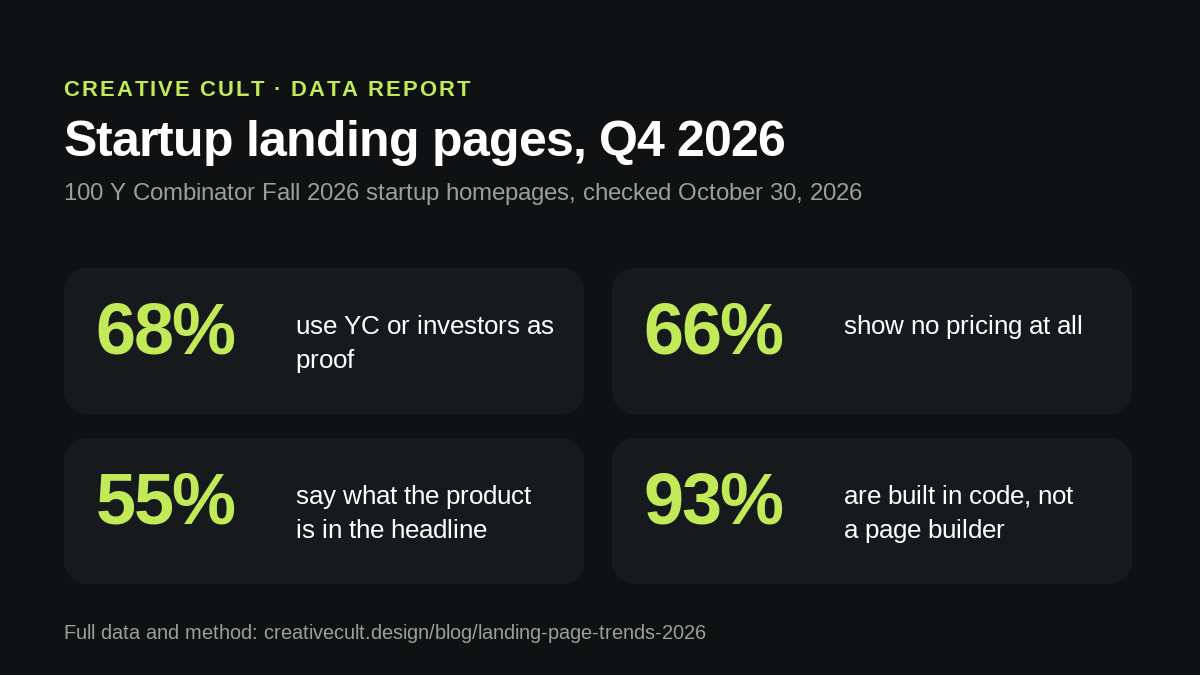
Startup landing pages in late 2026 lean on their investors, hide their prices and are built in code. We read the homepages of the 100 most recently launched Y Combinator Fall 2026 startups on October 30, 2026: 68 use YC or investors as proof, 66 show no pricing, and 93 are coded rather than made on a page builder.
Key takeaways
- 68 of 100 YC Fall 2026 startups use YC or their investors as proof, and for 42 of them it is the only proof on the page.
- Only 21 of the 100 show any customer evidence: a customer logo or a quote from a named person.
- 66 of the 100 show no pricing at all, including 32 of the 34 startups whose first button books a demo or a call.
- 55 of the 100 headlines say what the product is or does; 26 are vague and 3 are just the company name.
- 93 of the 100 sites are built in code (41 on Next.js), and only 7 on a site or AI builder such as Webflow or Framer.
What did we look at?
The 100 most recently launched companies in YC’s Fall 2026 batch, taken from the public yc-oss API, which mirrors YC’s company directory and was updated on October 30, 2026. They launched between September 23 and October 29, 2026: 50 are B2B, 20 industrial, 11 healthcare, 8 consumer, 6 fintech and 5 in other fields.
For each homepage we recorded the headline, the buttons, the proof, the pricing and the tools behind the site. The full method is at the end, and the raw data is a free CSV with one row per startup.
What do startup landing pages use as proof?
Mostly their investors. 68 of the 100 point to YC or their investors, usually with a “Backed by Y Combinator” line or badge, and 43 use those exact words. For 42 startups that is the only proof on the page: no customer logo, no quote and no usage number.
Customer evidence is rare. Only 21 of the 100 show a customer logo or a quote from a named person, which makes sense for companies that launched weeks ago. Numbers fill some of the gap: 33 show a usage or results figure.
The badge works as a first filter, because it tells a buyer a known investor checked the company. It does not tell them the product works for someone like them. We’d keep the badge and add one piece of proof a customer can check, even a single named quote from a pilot.
Do startup landing pages show their pricing?
Most do not. 66 of the 100 show no pricing at all: no Pricing link in the menu and no price on the homepage. 26 have a Pricing link and 21 print at least one price on the homepage itself.
How a startup sells decides it. Of the 34 whose first button books a demo or a call, 32 show no pricing. Of the 36 whose first button lets you sign up or try the product, 20 show pricing. The prices that do appear are plain and specific: Orgo says “Plans start at $29 a month.” and Databuddy says “Free up to 10,000 events a month, then from $9.99 a month.”
If a buyer can start without talking to you, show the price. If every deal is custom, a starting price or a typical range still answers the first question a buyer has. Our SaaS website design guide covers how the pricing page itself should work.
What is the first button on a startup landing page?
It splits almost evenly between self-serve and sales. 36 of the 100 lead with signing up or trying the product, and 34 lead with booking a demo or a call. 47 heroes have two buttons, 42 have one and 11 have none.
Industry shapes the button. 11 of the 20 industrial startups lead with a demo, a call or a meeting, against 15 of the 50 B2B software startups, where 25 lead with self-serve. Waitlists are rare: only 5 of the 100 lead with one.
A new kind of button has appeared for developer tools. Superserve leads with “Copy prompt for your coding agent” and EveryApp with “Copy the setup prompt”: the first step is to hand the product to an AI coding agent, not to a person.
How do startup headlines work?
Most say what the product is. 55 of the 100 headlines name the product or what it does, 16 promise an outcome, 26 are vague, and 3 are just the company name. The median headline is 6 words long.
| Type | Startup | Headline |
|---|---|---|
| Says what it is | ernd | The credit card for inference and GPU spend |
| Says what it is | Kairos Health | The AI front desk built for dental |
| Promises an outcome | Telamont | Catch the risks buried in your construction documents. |
| Promises an outcome | Rodeo Robotics | Keep your fleet moving |
A vague headline costs most when nobody knows the company yet. A visitor who cannot tell what you sell from the first line has to work for it, and many will not. Naming the product category is the cheapest fix on this list. To check your own, paste it into our free landing page copy scorer.
What are startup landing pages built with?
Code, overwhelmingly. 93 of the 100 sites are built in code and only 7 on a site or AI builder. Next.js leads with 41 sites, then 23 hand-coded HTML and JavaScript sites with no framework at all, 16 React single-page apps and 10 Astro sites.
Hosting is just as concentrated: 43 run on Vercel and 35 on Cloudflare. Our read: technical founders now build the first site themselves, often with an AI coding agent, rather than reach for a page builder.
What should your landing page copy from this?
Copy what the strongest pages do, and fix what most of them skip. In order of the page:
- Say what the product is in the headline, in about 6 words.
- Keep the investor badge, and add one piece of proof a customer can check: a named quote, a logo you have permission to show, or a usage number.
- Show a price if people can start without talking to you. If every deal is custom, show a starting price or a range.
- Pick one first button that matches how you sell: sign up for self-serve, book a demo for sales-led, or copy a prompt for developer tools.
- Put the product on screen under the headline: a screenshot, a short video or a demo.
For the full page structure, see the landing page wireframe and SaaS landing page examples. For 30 more startup homepages read the same way, see the best startup websites of 2026.
Can I use this data?
Yes. The full dataset has one row per startup with every field we recorded. Use it, chart it or quote it, with a link back to this page. The summary graphic is free to embed with this code:
How we collected the data
- Sample: the 100 most recently launched of the 190 Fall 2026 companies with a website in the yc-oss API (batch file updated October 30, 2026), sorted by launch date.
- Rendered read: each homepage was loaded in a browser-based fetch on October 30, 2026. We recorded the headline, the first two hero buttons, the menu button, a Pricing link, any price, embedded video, and every proof type, quoting the page exactly.
- Code read: the raw HTML of each homepage was checked for public markers of the framework or builder (for example `/_next/` for Next.js or `framerusercontent.com` for Framer) and response headers for the host.
- Classification: we sorted headlines into four types and first buttons into seven, by hand (the rules are in the FAQ below). Where the hero had no button, the main menu button counts.
- Limits: one day and one page per company. Pages change often at this stage, rotating heroes show one variant, and builder detection from markers can miss custom setups.
What a landing page costs with Creative Cult
We design and build landing pages for startups in production-ready code, the same way 93 of these 100 sites are built. A landing page starts at $900: custom design, responsive on every screen and with SEO basics set up. A website of up to 5 pages starts at $2,000, and our brand starter (logo, colors, typography and a mini brand guide) starts at $1,200.
After one intro call we can start the next business day, and first designs arrive within a week. See pricing or book an intro call.
Frequently asked questions
Why YC startups?
They are a public, well-defined group of companies launching at the same time, and YC’s directory lists each one’s website. That makes the sample easy to check and repeat each quarter.
How did you sort the headlines and buttons?
A headline “says what it is” when it names the product or what it does, “promises an outcome” when it states a result for the buyer, and is “vague” when it does neither. A button counts as “book a demo or a call” for any demo, call, meeting or contact request, and as “sign up or try it” for any self-serve start, free or paid.
Does showing “Backed by Y Combinator” help conversions?
This data cannot say, because it records what pages show, not how they perform. It shows how common the badge is: 68 of 100 pages lean on investors or YC as proof.
My startup is in the data and the row is wrong. What should I do?
Email hello@creativecult.design with the row number and the change. Pages change fast at this stage, and we will correct the CSV.
Sources
- yc-oss: public API for Y Combinator companies, yc-oss, October 30, 2026
- Orgo homepage, Orgo, October 30, 2026
- Databuddy homepage, Databuddy, October 30, 2026
- Superserve homepage, Superserve, October 30, 2026
- EveryApp homepage, EveryApp, October 30, 2026